N.B.
This information is provided for general guidance only and is not a substitute for the manufacturer’s instructions, a site-specific risk assessment, applicable UK requirements or advice from a competent hydraulic professional. Hydraulic systems can contain high pressure and stored energy and may cause serious injury or death if incorrectly selected, assembled, installed, inspected or maintained. Never work on a pressurised system. Isolate, lock out and depressurise equipment before work, and use correctly specified, compatible components and approved assembly and testing procedures. If in doubt, stop work and seek competent professional advice. To the fullest extent permitted by law, Ardel OEM Limited accepts no responsibility for reliance on this information, subject to any liability that cannot lawfully be excluded or limited.
Hydraulic hose construction and pressure ratings
Hydraulic hoses are engineered systems rather than simple rubber tubes. Their design and manufacture balance pressure capacity, flexibility, impulse resistance, bend radius and external protection to meet the demands of their intended application. We stock and supply a wide range of hydraulic hoses from market leading brands Bridgestone and Intertraco both expert in their field. Intertraco also manufactures one- and two- piece hoses fittings and ferrules.
Hose construction
A hydraulic hose has three main elements: an inner tube, reinforcement and an outer cover. The tube carries the fluid, the reinforcement contains the pressure, and the cover protects against abrasion, ozone, UV, oil, weather and other external damage. More demanding designs use additional reinforcement for higher working and burst pressures, together with specialised cover compounds for harsher environments.
1 wire braid
A one-wire braid hose has one layer of high-tensile steel wire around the tube. It suits low- to medium-pressure circuits where flexibility, compactness and cost matter more than extreme pressure capacity. Typical working pressures range from about 725 to 3,265 psi, depending on size, and the construction is commonly associated with SAE 100R1.
2 wire braid
A two-wire braid hose uses two braided steel-wire layers for greater strength and pressure capacity. Widely used in general machine hydraulics, it combines flexibility, pressure performance and service life. Typical working pressures range from about 1,300 to 5,800 psi, depending on size and specification, and the construction is commonly linked to SAE 100R2.
4 wire spiral
A four-wire spiral hose uses spiral-wound rather than braided reinforcement. Although stiffer, it is better suited to high-pressure circuits and severe impulse loading. Typical working pressures range from about 3,600 to 6,500 psi, depending on size and design. Applicable families may include SAE 100R9, SAE 100R12 and SAE 100R13 or 4SP-type hoses, depending on the exact construction and standard.
6 wire spiral
A six-wire spiral hose is built for the most demanding hydraulic systems, particularly where pressure spikes and fatigue life are critical. It supports constant high-pressure service and severe-duty applications such as breakers and hammers. Typical working pressure is about 5,000 to 6,000 psi, and some designs are classed as constant-pressure hoses. This construction is most closely associated with SAE 100R15 and certain high-performance R13/R15 hoses.
SAE R rating
The SAE R system identifies a hose’s construction, performance category and pressure capability—not just its size. R1 and R2 generally denote braided hoses, while specifications for spiral hoses address more demanding pressure and impulse performance. A hose may fit physically yet still be unsuitable for the system’s pressure, impulse load or duty cycle. The SAE R rating therefore helps specifiers select a safe hose for the operating conditions.
Constant pressure and compact hoses
Constant-pressure hoses maintain the same working-pressure rating across all sizes, simplifying selection and providing predictable performance where pressure remains high regardless of bore size. Compact hoses suit restricted routing spaces because their smaller outside diameter and greater flexibility reduce bulk and ease installation.
Thin covers and special covers for hose protection
Thin-cover hose
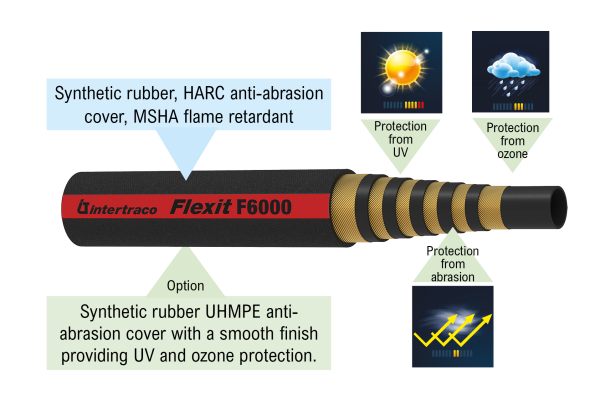
A thin-cover hose has a reduced outer layer, making it more compact and flexible while retaining high-pressure performance. Bridgestone and Intertraco use this term for spiral hose ranges such as 4ST, 4ST+, 4SF+, and 6ST.
HARC cover
HARC stands for high abrasion-resistant cover. This upgraded rubber outer layer withstands rubbing, dragging and harsh conditions better than a standard cover. Catalogues often list it as an optional anti-abrasion cover, sometimes with low-temperature ratings such as -50°C (-58°F).
MSHA cover
An MSHA cover uses a flame-retardant hose-cover compound approved for mining environments under MSHA requirements. Catalogues describe it as an MSHA-approved synthetic rubber cover, rather than a separate mechanical cover type.
UHMWPE cover
UHMWPE stands for ultra-high-molecular-weight polyethylene, a highly abrasion-resistant outer skin. It is available on request for hose applications exposed to extreme wear.
Summary
Thin cover: reduced thickness for greater compactness and flexibility.
HARC: an upgraded rubber cover for greater abrasion resistance.
MSHA: a flame-retardant approval for the cover compound.
UHMWPE: a polyethylene wear layer for extreme abrasion resistance.
For example, a hose may be specified as a “four-wire spiral thin-cover hose” with an optional HARC anti-abrasion cover and MSHA flame-retardant approval for heavy-duty, safety-critical applications.
Production process
Production begins with selecting compounds for the tube and cover. The inner tube is extruded, reinforcement is braided or spiralled around it, and the outer cover is applied before curing and finishing. Quality checks verify pressure performance, dimensions, cover integrity and compliance with the relevant SAE or EN standard. The finished hose is a purpose-engineered pressure vessel balancing strength, flexibility and environmental resistance.
ISO and SAE ratings and standards
Here is a practical cross-reference table showing the common SAE 100R hose ratings and the closest ISO 18752 matches. ISO 18752 is pressure-class based, so the relationship is not always a strict one-to-one equivalence, but this is the usual industry mapping for selection purposes.
SAE ISO rating Typical ISO 18752 match Relationship Bridgestone hoses Intertraco hoses
100 R1AT ISO 18752 AS/BS Commonly treated as comparable for single wire braided hoses R1K Flexit 1T
Flexit HT1
100 R2AT ISO 18752 BS/CS Commonly treated as comparable for two-wire braided hoses R2K Flexit 2T
Flexit HT2
100 R3 ISO 18752 no match R3 is a fibre reinforced low/medium pressure hose. No ISO equivalent.
100 R5 ISO 18752 no match R5 is a textile covered wire reinforced medium pressure hose. No ISO equivalent. Flexit R5
100 R12 ISO 18752 C/D classes Comparable for spiral wire high pressure hoses
4ST IIFlexit SHP II
100 R13 ISO 18752 C/D classes Comparable for heavy-duty spiral wire hose with higher pressure and impulse demands Flexit F5000
100 R15
ISO 18752 C/D classes
Comparable for very high pressure applications
4ST +
4SF +
6ST IIFlexit F6000
100 R16 ISO 18752 BC/CC/DC classes Often mapped to compact braided hose classes with similar performance envelope Flexit SC216
100 R17
ISO 18752 BC/CC/DC classesCommon compact hose comparison, depending on working pressure and impulse requirements Flexit SC117
Flexit SK117
Flexit SC216
Flexit SK216
100 R19
ISO 18752 BC/CC/DC classesSimilar compact hose family, selected by pressure class, rather than construction alone Flexit SK119
Flexit SK219
How to read it
ISO 18752 groups hoses by maximum working pressure and performance class, while SAE 100R labels hoses mainly by construction and application family. That means the “same” hose may land in different ISO 18752 classes depending on working pressure, impulse resistance, and temperature rating. In practice, suppliers often publish a tighter equivalence chart for their own product lines, because the exact match depends on the hose datasheet.
Useful rule of thumb
- SAE 100R1 and R2 usually align with lower ISO 18752 braid classes such as AS, BS, or CS.
- SAE 100R12, R13, and R15 usually align with higher ISO 18752 spiral classes such as C, D, E, or F depending on pressure.
- SAE 100R16, R17, and R19 are commonly compared to compact ISO 18752 braid classes such as BC, CC, or DC.
More on ISO 18752
ISO 18752 is built from three layers of classification: class for pressure, grade for impulse durability, and type for hose outside-diameter style. The practical effect is that you specify a hose by performance first, not by braid/spiral construction first.
Class structure
The class is the pressure rating. ISO 18752 defines ten classes, and each class has one maximum working pressure that applies across all permitted hose sizes in that class. In the current edition, the classes are 35, 70, 140, 210, 250, 280, 350, 420, 490, and 560. The hoses are rated in bar.
Grades and types
The grade describes resistance to impulse, with four grades: A, B, C, and D. The type describes whether the hose is standard or compact: AS, BS, and CS are standard types, while AC, BC, CC, and DC are compact types. Higher grades generally carry higher impulse endurance and, for some grades, higher temperature capability.
| Grade | Typical hose types | Test temperature °C | Impulse pressure of MWP | Minimum impulse cycles |
|---|---|---|---|---|
| A | AS/AC | 100 | 133% | 200,000 |
| B | BS/BC | 100 | 133% | 500,000 |
| C | CS/CC | 100 | 133%* | 500,000 |
| D | DC | 100 | 133% | 1,000,000 |
| * For grade C at pressure classes 350, 420, 490, and 560, the impulse pressure is 120% of MWP. | ||||
Think of the grades as increasing durability against repeated pressure spikes:
Grade A → Grade B → Grade C → Grade D
- Grade A: 200,000 cycles — basic impulse resistance.
- Grade B: 500,000 cycles — 2.5× the cycle endurance of Grade A.
- Grade C: 500,000 cycles, but tested at the higher 120°C temperature, making it suitable for more demanding high-temperature applications.
- Grade D: 1,000,000 cycles — the highest impulse endurance in ISO 18752.
Importantly, Grade D does not mean a higher maximum working pressure than Grade A. The pressure class (e.g. 210, 350, 420 bar) determines the hose’s maximum working pressure, while the grade determines impulse endurance.
Simple example
Suppose a hose has a maximum working pressure (MWP) of 280 bar.
For a Grade A hose, the impulse test pressure would be:
280 × 1.33 ≈ 372 bar, and the hose must withstand at least 200,000 pressure cycles at the specified test temperature.
A Grade B hose at the same 280-bar MWP would also be tested at approximately 372 bar, but must survive 500,000 cycles.
Class = pressure capacity; Grade = impulse-life/durability.
Design impact
For design, ISO 18752 lets engineers build around a pressure target that stays constant across size ranges, instead of re-rating each diameter separately. That usually simplifies catalogue design, reduces the number of near-duplicate part numbers, and makes it easier to create a family of hoses that share the same pressure class across multiple sizes. It also shifts attention to impulse performance and temperature capability when selecting the grade.
Production impact
For production, the standard encourages a more modular product line. Manufacturers can focus on meeting a defined pressure class and grade, then vary construction details to hit standard or compact form factors. That can simplify quality control, because the core pass/fail target becomes the class pressure and impulse requirement rather than a hose being defined mainly by its layer count or reinforcement style.
Selection impact
For selection, the biggest practical change is that users choose by working pressure, impulse life, size, and temperature, not just by whether a hose is single braid, double braid, or spiral wire. This makes cross-brand comparison easier when products are genuinely ISO 18752-compliant, because the class and grade give a clearer performance basis. A compact type such as BC or DC may fit where space is tight, while a standard type such as BS or CS may be preferred when bend radius or legacy fit is the priority.
Simple example
A machine designer needing the same pressure capability across several bore sizes could specify one ISO 18752 class and then choose the grade based on how severe the pressure cycling is. If packaging space is constrained, the designer might move from a standard to a compact type while keeping the same pressure class and grade target.
To see an infographic of this content click here.