In a hydraulic circuit, pressure creates force, flow controls operating speed, and hose bore determines how easily oil moves. Choose a hose that meets both the pressure and flow requirements; neither alone is sufficient.
Pressure, flow, and hose bore
- Pressure, measured in bar or psi, depends mainly on the load and relief-valve setting. It determines the force available from cylinders and motors.
- Flow is the volume of oil delivered per unit of time, usually measured in L/min or US gpm. It determines actuator speed: more flow moves the boom, stick, or bucket faster.
- Hose bore, or inside diameter (ID), determines fluid velocity at a given flow rate. Halving the bore roughly quadruples velocity because cross-sectional area is proportional to the square of the diameter.
- Excessive velocity increases friction, pressure loss, heat, noise, cavitation risk in suction lines, and wasted engine power. An oversized bore adds weight, cost, stiffness, and routing difficulty without improving useful output.
Pressure lines typically operate at 15–25 ft/s (4.6–7.6 m/s). Return lines usually require lower velocities, and pump suction lines must run slower still to avoid cavitation.
Why pressure ratings fall as hose size increases
With the same construction, a hose’s working-pressure rating decreases as its bore increases. Pressure creates hoop stress in the hose wall, so a larger bore produces greater wall force at the same pressure and requires more reinforcement to maintain the rating.
Small-bore hoses can therefore be compact yet withstand very high pressure. A 3-inch hose is generally larger and heavily reinforced, but is designed for high flow rather than extreme pressure.
Effects of choosing the wrong bore
- Too small: Velocity and pressure loss rise sharply, slowing cylinders, heating the circuit, reducing efficiency, and intensifying pressure spikes. Pressure loss increases roughly with the square of velocity.
- Too large: Pressure loss decreases, but the hose is heavier, costlier, harder to route, and may have a lower pressure rating for the same construction. In low-flow control circuits, it can also reduce response.
- Correct size: The hose carries the maximum circuit flow at an acceptable velocity, and its working-pressure rating exceeds the highest expected pressure, including shock loads and the relief-valve setting.
Excavator example
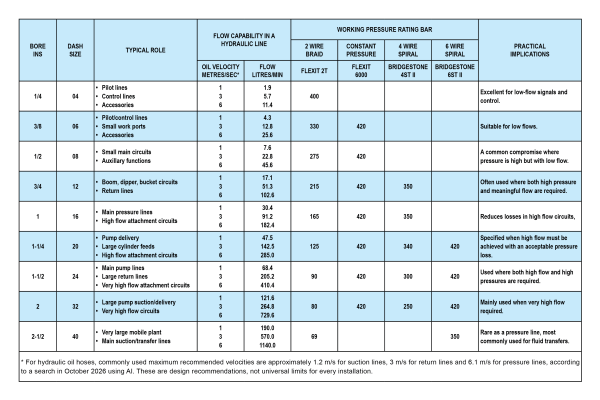
A 1/4-inch pilot hose may carry only a few litres per minute to operate a control valve, so its small bore is appropriate. By contrast, a large excavator’s boom-cylinder line may carry tens or hundreds of litres per minute. A 1/4- or 3/8-inch hose would severely restrict that flow, so a 3/4-inch, 1-inch, or larger hose is used to limit velocity and heat.
For hydraulic hoses, commonly used maximum recommended velocities are approximately 1.2 m/s for suction lines, 3 m/s for return lines and 6.1 m/s for pressure lines, according to a search in October 2026 using AI. These are design recommendations, not universal limits for every installation.
The distinction is straightforward: pressure rating protects against hose failure, while bore sizing limits restriction, heat, and performance loss. A hose may meet the pressure requirement and still be too small for the required flow.